

VAT REFLECTION IN INTERNATIONAL TRANSACTIONS
INTERNATIONAL TRANSACTIONS, reflection of VAT,
possible schemes and necessary documents
In the laws and directives on VAT, EU countries are a community, and transactions within the EU are intra-community. In the text below, countries that are not members of the European Union are united by the concept of “third countries”.
It is very important that all primary accounting documents have a translation into Bulgarian. This is necessary not only for accountants of companies for accounting, but also for passing inspections of controlling organizations without additional fines and comments.
Consider the private situations of applying VAT in practice.
When preparing a transaction, it is first necessary to determine the jurisdiction and status of partners, as well as whether they are VAT payers? For companies registered in the European Union, this can be done using the VIES - VAT information exchange system, at the following link: https://europa.eu/youreurope/business/vat-customs/check-number-vies/index_en.htm
When making payments from which VAT liabilities arise, it is necessary to pay attention to the timing in order to have a margin in time for using a tax credit or paying VAT on time.
EXAMPLES OF VARIOUS TRANSACTIONS
EXAMPLE No. 1. SALE OF GOODS FROM BULGARIA TO THE COUNTRIES OF THE EUROPEAN UNION
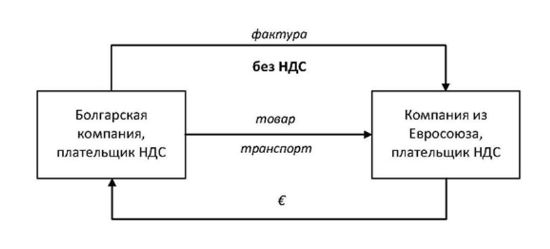
The Bulgarian company sells the goods of the EU company, which is a VAT payer, is shown in the following diagram
If the Bulgarian company is a VAT payer, it delivers the goods to the counterparty, the company of the European Union, which is also a VAT payer, in this case the VAT will be zero based on Art. 84 and Art. 17 of the Law on Value Added Tax (ZNDS).
The documents required by a Bulgarian company for accounting in this case are as follows:
1. Invoice for sale and Purchase order (application from the buyer).
2. Payment order confirming payment between the buyer and seller.
3. The contract, the transceiver protocol.
4. CMR, invoice / invoice for transport.
5. VIES - declaration.
When filling out an invoice, it is necessary to indicate the basis for not charging VAT.
The basis for non-charging VAT in the invoice or invoice in this case is Art. 84 and Art. 17 ZNDS - the delivery of goods is carried out outside the territory of Bulgaria
Sample texts that can be used when filling out invoices and invoices are as follows:
| На русском: |
На болгарском: |
|
Поставка не подлежит обложению НДС в Болгарии, согласно ст.84 и в связи со ст.17 ЗНДС НДС взыскивается с получателя товара (услуги). |
Доставката не подлежи на облагане с ДДС в България съгласно чл.84, и във връзка с ДДС се дължи от получателя на стоките (услугите). |
In Bulgarian:
Deliveries are not subject to tax from the VAT to Bulgaria in accordance with Part 84, and having taken
tsp 17. VAT
VAT from the recipient to the stock (service).
EXAMPLE No. 2. SALE OF GOODS FROM BULGARIA TO THE EUROPEAN UNION COUNTRIES TO A CONTAGENT WHICH IS NOT A PAYER OF VAT OR INDIVIDUAL
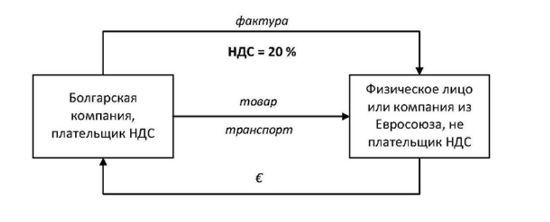
A Bulgarian company selling goods to an EU country to an individual or company that is not a VAT payer is shown in the following diagram:
In case of delivery of goods from Bulgaria to the EU country to an individual or company that is not a VAT payer, the Bulgarian company - a VAT payer, is obligated to pay VAT in Bulgaria.
The documents required by a Bulgarian company for accounting in this case are as follows:
1. Invoice for sale and Purchase order (application from the buyer).
2. Payment order confirming payment between the buyer and seller.
3. The contract, the transceiver protocol.
4. CMR, invoice / invoice for transport.
EXAMPLE 3. EXPORT OF GOODS FROM BULGARIA TO THIRD COUNTRIES
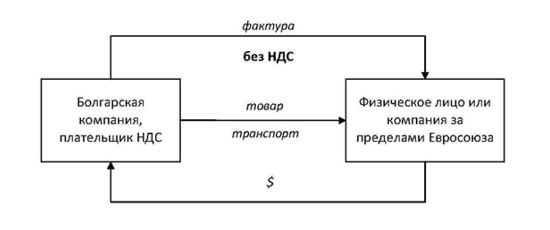
The sale of goods by a Bulgarian company to an individual or company located outside the European Union is shown in the following diagram:
In the event that the Bulgarian company delivers the goods to the counterparty outside the EU, VAT is not charged. In this case, it does not matter whether the counterparty is a VAT payer.
The documents required by a Bulgarian company for accounting in this case are as follows:
1. Invoice for sale and Purchase order (application from the buyer).
2. Payment order confirming payment between the buyer and seller.
3. Agreement (it is desirable to have a transceiver protocol).
4. Customs declaration for sale.
5. CMR, invoice / invoice for transport.
The main reasons for not charging VAT on an invoice or invoice:
Art. 69 al. 2 and Art. 21 al. 2 ZNDS - the place of service is located outside the territory of Bulgaria: service to a third country
Art. 28 from ZNDS and Art. 86 - Taxable delivery with a zero rate - the delivery of goods is carried out outside the territory of Bulgaria in a third country
Art. 30 (1) A taxable supply with a zero rate is the transport of goods (transport service) to a third country
Sample texts that can be used when filling out invoices and invoices are as follows:
In Russian: In Bulgarian:
Delivery is not subject to VAT in Bulgaria, VAT is collected from the recipient of the goods (service). Deliveries are not subject to tax from DDS to Bulgaria, DDS from the recipient to stock (service).
EXAMPLE No. 5. PURCHASE OF GOODS BY A BULGARIAN COMPANY FROM EUROPEAN UNION COUNTRIES
A Bulgarian company purchasing goods from an EU country from a VAT payer is shown in the following diagram:
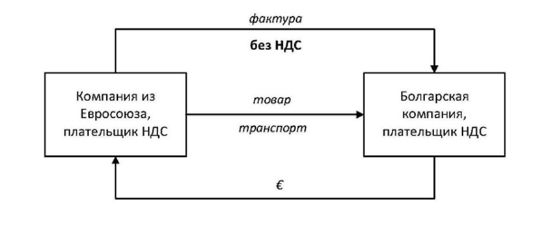
If a Bulgarian company buys and imports goods (receives services) from another EU country, before the transaction it is necessary to make sure that the supplier is registered as a VAT payer. This can be done using the link provided at the beginning.
The supplier issues a VIES declaration, and the Bulgarian company is obligated to pay VAT and accrues 20% VAT in Bulgaria with the protocol under Art. 117 ZDDS. If the product or service will be used for commercial purposes of the company, there is a right to VAT refund in the same period. (That is, VAT is not really paid)
The documents required by a Bulgarian company for accounting in this case are as follows:
1. The invoice from the seller for the purchase and Purchase order (application from the buyer).
2. Payment order confirming payment between the buyer and seller.
3. Customs declaration upon purchase for import into Bulgaria, issued by the EU customs authority, if the seller bought the goods in a third country (copy)
4. VIES declaration.
5. Invoice for transport - the original / when the buyer pays for the transport / or copy / when the transport is paid by the seller / and CMR.
EXAMPLE 6. IMPORT OF GOODS TO BULGARIA FROM THIRD COUNTRY
The purchase by a Bulgarian company of goods from a country outside the European Union is shown in the following diagram:
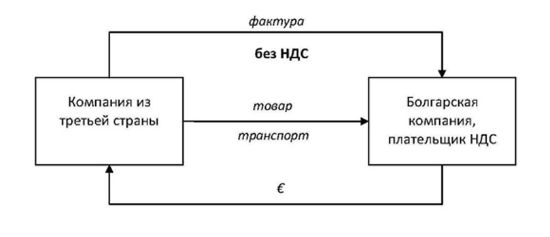
If a Bulgarian company buys and imports goods from other countries, it is very important to know that the value of the goods and the costs of its transportation, as well as customs fees and duties, are included in the taxable amount under the transaction.
A Bulgarian company is obliged to pay 20% VAT as soon as the goods arrive at the customs territory of the European Union. Moreover, she receives the right to a tax credit in the current reporting period. The first time the VAT refund period is 3 +1 months (filing for a refund after 3 months, 1 month the period for checking documents), after that it is submitted for VAT refunds every month, the verification of documents is also 1 month.
The documents required by a Bulgarian company for accounting in this case are as follows:
1. The invoice from the seller for the purchase and Purchase order (application from the buyer)
2. Agreement, (preferably the transceiver protocol).
3. Payment order confirming payment between the buyer and seller.
4. Customs declaration upon purchase for import into Bulgaria.
5. Invoice for transport - the original / when the buyer pays for the transport / or a copy / when the transport is paid by the seller /. CMR
EXAMPLE No. 7. TRILATERAL OPERATION OUTSIDE THE EUROPEAN UNION:
Bulgarian company is an intermediary in a purchase and sale transaction outside the European Union
A situation where two companies, a buyer and a seller, are outside the European Union.
The first company, for example from Russia, is a supplier of goods.
The second company is a Bulgarian company, which is an intermediary, (BUT NOT A COMMISSIONER).
A third company, such as a Turkish company, is the purchaser of the goods (end customer).
The transaction scheme is as follows:
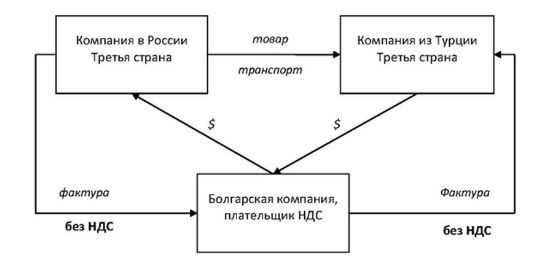
The main reasons for not charging VAT on the invoice
Art. 69 al. 2 and Art. 21 al. 2 ZNDS - the place of service is located outside the territory of Bulgaria: service to a third country
Art. 28 from ZNDS and Art. 86 - Taxable delivery with a zero rate - the delivery of goods is carried out outside the territory of Bulgaria in a third country
The documents required by a Bulgarian company for accounting in this case are as follows:
1. Agreement
2. The invoice from the seller for the purchase and Purchase order (application from the buyer).
3. Payment order confirming payment between the buyer and seller.
4. Customs declaration upon purchase.
5. Customs declaration upon sale.
6. Invoice for transport - the original / when the Bulgarian company pays for the transport / or copy / when the transport is paid by the seller or buyer /.
7. CMR
If the Bulgarian company is an intermediary or commission agent in the sale of services, the following documents are required:
1. An invoice from the seller for the purchase or sale,
2. Bank statements on the transfer of invoices,
3. An agreement, protocol on acceptance of services, e-mail or other type of correspondence confirming the performance of services,
• Request
• Transmission protocol.
EXAMPLE No. 8. TRILATERAL OPERATION IN THE EUROPEAN UNION:
Bulgarian company intermediary in the transaction of sale within the European Union
Consider the situation when three companies are located in the European Union and all are VAT payers (while these companies do not have VAT registration in the countries where they deliver or where they purchase goods)
The first company, for example from France, produces goods and acts as an assignor, i.e. a person who transfers his right to receive money under a monetary obligation to another person, in our case, a Bulgarian company.
The second company is a Bulgarian company, which is an intermediary, a VAT payer in Bulgaria, and is not registered as a VAT payer in France.
A third company, such as a German company, is the purchaser of the goods (end customer).
The transaction scheme is as follows:
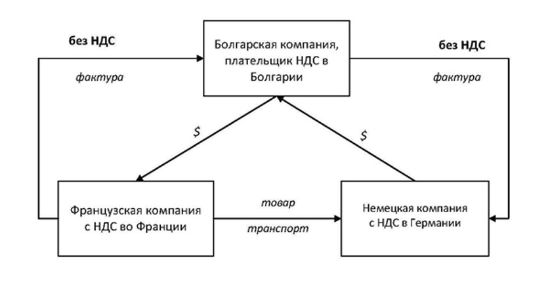
For this transaction, it is necessary to be guided by Article 141 of the EU Directive 2006/112 / EO. It is very important that the decision to sell the goods was made in Bulgaria, and this was reflected in the documents.
Then the manufacturer (French company) will have VAT equal to zero.
An intermediary (a Bulgarian company) will have an obligation to issue a VIES declaration and VAT will be zero according to Art. 21 ZNDS - the place of service is located outside the territory of Bulgaria; tax paid by the recipient, service in the EU, and Art. 28c (E) (3) 77/388 / EEC - the person is an intermediary in a tripartite transaction, the tax is paid by the recipient.
The acquirer (a German company) will have an obligation to pay VAT in Germany, and at a rate of 19% (accepted in Germany).
The transaction documents that need to be prepared under Article 9 of the LARP (Rules for the Application of the Law on Value Added Tax) in this case are as follows:
1. Agreement
2. Invoice with VAT number of the manufacturer, which is issued to the intermediary.
3. Invoice with VAT number of the intermediary, which is issued to the consumer.
4. VIES declaration issued by the intermediary.
5. Written confirmation of the transaction (required).
6. Copy of the bill of lading.
7. Bank documents confirming payment.
EXAMPLE No. 9. TRILATERAL EXPORT OPERATION FROM THE EUROPEAN UNION TO THE THIRD COUNTRY:
Bulgarian company is an intermediary in a transaction for the escort of goods to a country outside the European Union
Consider a situation where a European company, through an intermediary, a Bulgarian company, sells goods to a third country.
The first company, for example from Greece, a VAT payer, sells goods.
The second company is a Bulgarian company, which is an intermediary (NOT a commission agent, i.e. buys goods), and is a VAT payer.
A third company, such as a Turkish company, is the purchaser of the goods (end customer).
The transaction scheme is as follows:
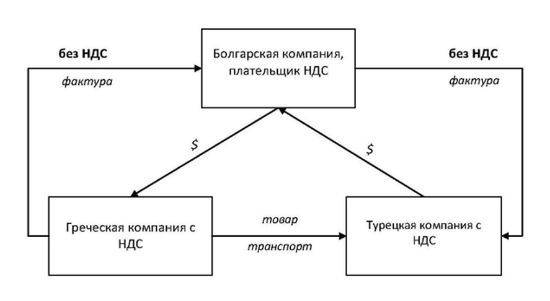
Attention! We do not recommend performing operations according to this example.
The seller (Greek company) sends the contract and issues the invoice to the intermediary, and will also issue the VIES declaration of the transaction.
The Bulgarian intermediary company issues an invoice to the acquirer of the Turkish company, and must draw up a protocol under Article 117 of the VAT in accordance with the invoice issued by the Greek company, BUT WITHOUT A TAX LOAN RIGHT.
The goods arrive in Turkey in transit without entering the territory of Bulgaria.
According to the ZNDS, in this case, the Bulgarian company, as a supplier of goods to a third country, must pay VAT, and loses the right to a tax credit!
The main reasons for not charging VAT on the invoice
Art. 69 al. 2 and Art. 21 al. 2 ZNDS - the place of service is located outside the territory of Bulgaria: service to a third country
Art. 28 from ZNDS and Art. 86 - Taxable delivery with a zero rate - the delivery of goods is carried out outside the territory of Bulgaria in a third country
The transaction documents must be prepared in accordance with article 9 of the LARP (Rules for the Application of the Value Added Tax Law):
1. Sales invoice and purchase order.
2. Payment order confirming payment and invoice for purchase.
3. Customs declaration upon purchase.
4. Customs declaration upon sale.
5. CMR, copy of the invoice for transport, transceiver protocol.
In this case, the transfer of ownership from the Greek company to Bulgarian and from Bulgarian to Turkish takes place on the territory of the EU, in Greece, in this case for the Bulgarian company there is an obligation to register for VAT in Greece!
Exit: transfer of ownership of the goods in the “Free Zone” or on the high seas AFTER CUSTOMS CLEARANCE (to avoid the registration of a company in Turkey), in which case the Greek company makes customs clearance of goods.
Transport costs before the goods leave the EU should be at the expense of the seller (Greek company).
If you really need to conduct a transaction according to such an example, please consult with specialists before the transaction begins, conduct the economic calculation of the transaction correctly taking into account the time and amount of payment of mandatory payments and taxes, check the counterparties and use mechanisms to increase your security, for example, a 100% prepayment to start shipment of goods.
When purchasing goods and their subsequent sale in Turkey, it is necessary to consult on possible registration requirements in accordance with Turkish law.
EXAMPLE 10. THREE-SIDED IMPORT OPERATION FROM THIRD COUNTRY TO ANOTHER STATE OF THE EUROPEAN UNION
Bulgarian company is an intermediary in a transaction for the import of goods from a country outside the European Union into a country of the European Union
Consider a situation where a European company through an intermediary, a Bulgarian company imports goods from a third country. PRACTICALLY IMPOSSIBLE SITUATION, if a Bulgarian company transfers ownership of the goods in another EU country and clears goods in the same EU country! Need to register a Bulgarian company for VAT in another EU country!
How is it possible to make a deal?
The first company, for example from Kazakhstan, produces goods and is a supplier. In this case, it does not matter whether the supplier is a VAT payer.
The second company is the Bulgarian company, which is an intermediary (BUT NOT A COMMISSIONER), and is a VAT payer. She will act as a supplier of goods to the European Union.
A third company, such as an Italian company, is the buyer of the goods (final recipient).
Goods in transit are sent from Kazakhstan to Italy.
The transaction scheme is as follows:
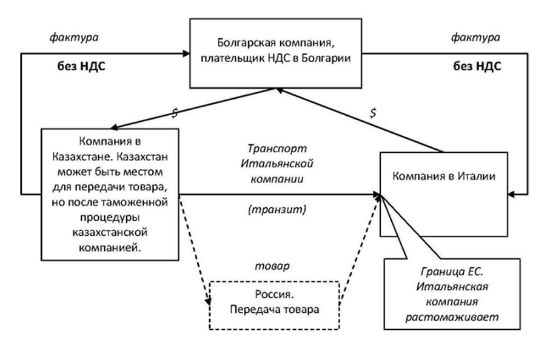
In Russia, there is a transfer of goods. The company in Italy is the final recipient of the goods. At the EU border MANDATORY CUSTOMIZED GOODS Italian company.
The seller, a company from Kazakhstan, invoices a broker. In Kazakhstan, there may be a place for the transfer of goods, BUT AFTER THE CUSTOMS PROCEDURE BY THE KAZAKHSTAN COMPANY.
The intermediary, a Bulgarian company, issues the invoice to the recipient according to Art. 28 and Art. 86 of the VAT, and transfers the goods to the Italian company before the goods enter the EU, therefore the place of transaction is located on the territory of Russia or Kazakhstan (OR BEFORE) the Italian border (goods are transferred outside outside the EU). Transportation of goods to the EU is at the expense of the end customer.
In this case, it is very important:
1) take into account the following detail: it is unacceptable to use delivery on Incoterms group “D” when the seller bears all shipping costs and assumes all risks until the goods are delivered to the destination country (DAT, DAP, DDP). The ownership of the goods from the Bulgarian company to Italian should be transferred to the border with the European Union or in the "Free Zone". (If the goods follow, for example, through Russia, the ownership of the goods from the Bulgarian to the Italian company can be exercised on the territory of Russia, i.e. any third country)
2) the Bulgarian company does not have to pay for transportation.
3) in this example there is no Intrast and VIES, since the transaction is not intra-community.
The documents required by a Bulgarian company for accounting in this case are as follows:
1. Agreement
2. Purchase invoice
3. Sales invoice
4. Kazakh customs declaration, in which the Bulgarian company is indicated as the recipient
5. EU Customs Declaration
6. CMR
7. Product insurance in the name of an Italian company
8. Bill of lading (copy)
The main grounds for non-accrual of VAT in the invoice
Applications
DOCUMENTS FOR PURCHASE OF GOODS
1. The invoice from the seller about the purchase and purchase order.
2. Payment order confirming payment between the Buyer and the Seller.
3. A customs declaration upon purchase of a third party for import into Bulgaria, issued by the customs authority of the EU / in transit sale, when the goods do not enter the territory of Bulgaria, but directly enter the third EU Member State, a copy of the customs declaration is needed /.
4. Customs declaration upon purchase from a third party issued by the customs authority of a third party.
5. CMR / for tripartite transactions in the EU between firms that are registered for VAT, CMR and a confirmation letter (LADING LIST, PACKING LIST, BILL TO SHIP) are required.
6. Invoice for transport - original / when the Buyer pays for Transport / or a copy / when transport is paid by the seller /.
It is necessary that all documents have a translation into Bulgarian.
DOCUMENTS FOR SALE OF GOODS
1. Sales invoice and purchase order.
2. Payment order confirming payment between the Buyer and the Seller.
3. Customs declaration upon sale of a third party.
4. CMR / for tripartite transactions in the EU between companies that are registered for VAT, CMR and a confirmation letter (LADING LIST, PACKING LIST, BILL TO SHIP) are required.
All documents must be translated into Bulgarian.
NECESSARY DOCUMENTS FOR PURCHASE AND SALE OF SERVICES
1. The seller’s invoice for the purchase or sale of services
2. Payment order confirming payment between the Buyer and the Seller.
3. An agreement, a protocol for the reception and transfer of services, e-mail or other type of correspondence proving an order or the execution and acceptance of a service.
All documents must be translated into Bulgarian.
Art. 69 al. 2 and Art. 21 al. 2 ZNDS - the place of service is located outside the territory of Bulgaria: service to a third country
Art. 28 from ZNDS and Art. 86 - Taxable delivery with a zero rate - the delivery of goods is carried out outside the territory of Bulgaria in a third country
The main reasons for not charging VAT on the invoice
art. 9 tbsp. 113 ZNDS (Law on Value Added Tax) - the person is not registered under the ZNDS
Art. 84 and Art. 17 ZNDS - goods are delivered outside the territory of Bulgaria to the EU
Art. 21 ZNDS - the place of service is located outside the territory of Bulgaria; recipient pays tax: service to EU
Art. 69 al. 2 and Art. 21 al. 2 ZNDS - the place of service is located outside the territory of Bulgaria: service to a third country
Art. 28 from ZNDS and Art. 86 - Taxable delivery with a zero rate - the delivery of goods is carried out outside the territory of Bulgaria in a third country
Art. 22 ZNDS - the place of execution of the transport service is located outside of Bulgaria in the EU
Art. 30 (1) A taxable supply with a zero rate is the transport of goods (transport service) to a third country
Art. 163a ZNDS - supply of waste; tax paid by the recipient
Art. 28c (E) (3) 77/388 / EEC - the person is an intermediary in a tripartite operation; tax paid by the recipient
h. 1 tbsp. 86 ППЗНДС (Rules for the application of the Law on Value Added Tax) - the supply of general tourism services
Sample texts that can be used when filling out invoices and invoices.
In Russian: In Bulgarian:
Delivery is not subject to VAT in Bulgaria, according to part ... Art. … due
with h ... Art. ...
VAT is collected from the recipient of the goods (services). Deliveries are not subject to tax on the DDS in Bulgaria according to t. ...., al. .... and vv
inc. ...., al. .....
DDS to collect from the recipient at the drain (service).